
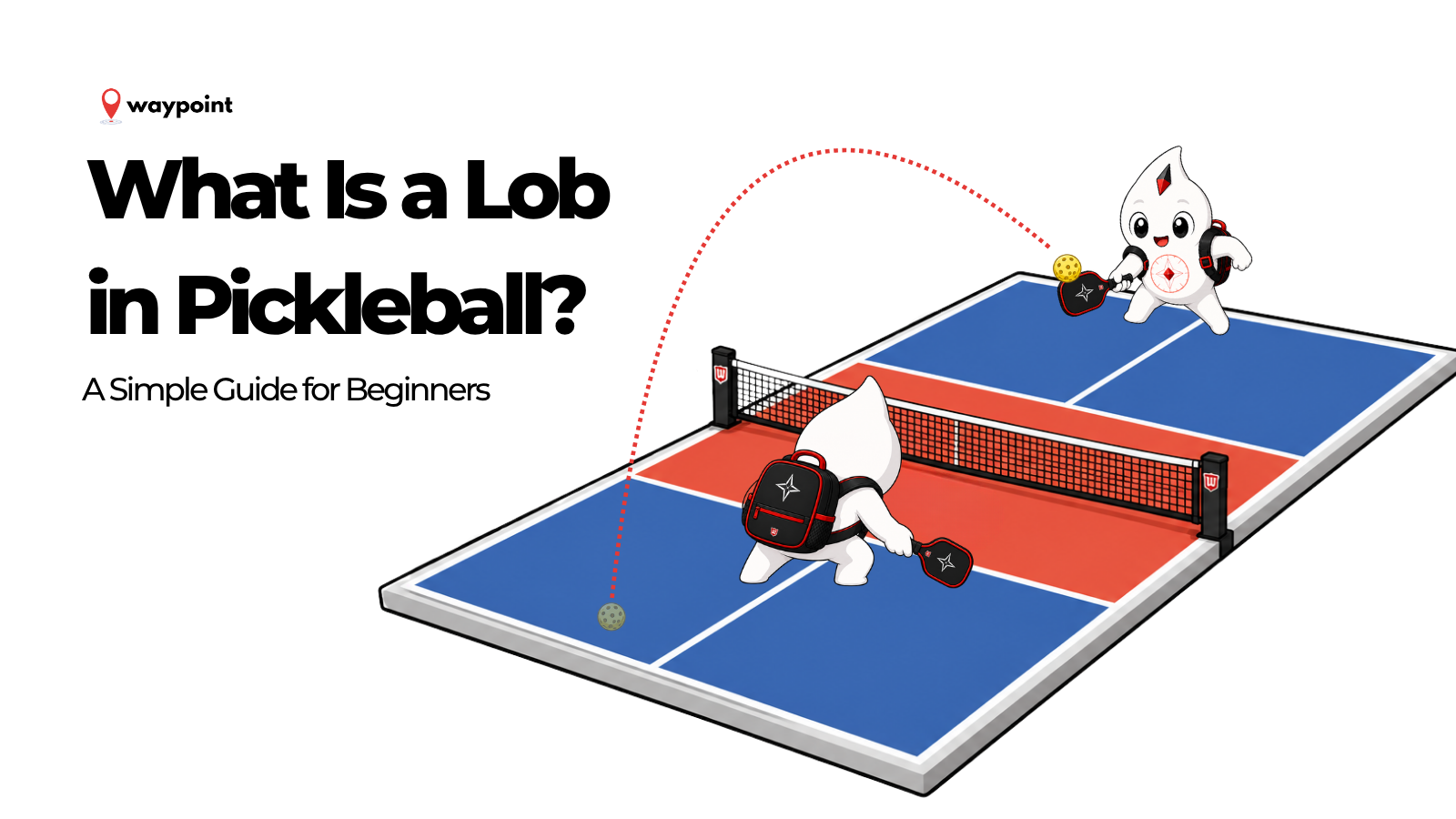

If you have seen a player send the ball high over an opponent’s head, you have already seen a lob.
A lob can push your opponent away from the kitchen line and give you more time to recover. However, if the ball is too low or too short, it may give your opponent an easy overhead shot.
Here is what a lob means, when to use one, and how to hit it with more control.
What Is a Lob in Pickleball?
A lob is a high shot that travels over your opponent’s head and lands deep in their side of the court.
It is often used when an opponent is standing near the kitchen line. A successful lob forces them to turn and move towards the baseline to reach the ball.
Unlike a drive, which travels quickly and low over the net, a lob follows a much higher path through the air.
The goal is not simply to hit the ball as high as possible. A good lob needs enough height to clear your opponent while still landing safely inside the court.
Why Do Players Use Lobs?
Players use lobs to change the pace of the rally and move their opponents away from the kitchen line.
A well-placed lob can:
- Push an opponent towards the baseline
- Create open space near the kitchen
- Give you time to recover your position
- Interrupt an opponent’s attacking rhythm
- Force an opponent to hit while moving backwards
Lobs can be especially useful when both opponents are standing close to the kitchen line and leaving space behind them.
However, lobbing too often can make your game predictable. It works best when your opponent is not expecting it.
Offensive vs Defensive Lobs
There are two common reasons to hit a lob.
An offensive lob is used when you are balanced and want to catch your opponent by surprise. It is usually hit with control and placed over an opponent who is standing close to the kitchen line.
A defensive lob is used when you are under pressure and need more time to recover. The extra height keeps the ball in the air longer, giving you a chance to move back into position.
An easy way to remember the difference is:
Offensive lob: Used to move your opponent and create an opportunity.
Defensive lob: Used to give yourself more time.
When Should You Hit a Lob?
A lob can be a good choice when your opponent is standing close to the kitchen line and there is open space behind them.
You may choose to lob when:
- Your opponent is leaning forward
- Your opponent has moved very close to the net
- You are balanced and have time to control the shot
- Your opponent has difficulty moving backwards
- You need more time to recover your position
Lobs are harder to control when you are off balance or reaching for a low ball.
It is also important to consider the playing conditions. Outdoor wind can move the ball and make the shot less predictable.
Where Should a Lob Land?
A lob should land deep in your opponent’s court, preferably near the baseline but still safely inside it.
A deep lob gives your opponent less room to move behind the ball. It can also make their return more difficult because they have to move away from the kitchen line.
Try to leave some space between your target and the baseline. Aiming directly for the line increases the chance of hitting the ball out.
You can also aim over an opponent’s backhand side, as turning and reaching for the ball may be more difficult from that position.
How to Hit a Lob
A lob should feel smooth and controlled rather than rushed.
Start with your paddle in front of you and move into a balanced position. Let the ball come to a comfortable height, then lift it using a gentle low-to-high motion.
The paddle face should be slightly open so the ball travels upwards.
Focus on these basics:
- Move into position before hitting.
- Keep your eyes on the ball.
- Contact the ball in front of your body.
- Use a smooth lifting motion.
- Give the ball enough height to clear your opponent.
- Aim deep, but leave space before the baseline.
- Return to your ready position.
Avoid suddenly flicking your wrist or swinging too hard. A calm and controlled motion will make the height and distance easier to manage.
Common Beginner Mistakes
Hitting the Lob Too Short
A short lob may land in the middle of the court and give your opponent an easy overhead.
Try to send the ball deep enough that your opponent has to move backwards.
Hitting the Ball Too Low
A low lob may not clear your opponent.
Give the ball enough height to travel safely over their reach, especially if they are tall or standing close to the kitchen line.
Hitting Too Hard
A lob needs height and depth, but not maximum power.
Hitting too hard can send the ball beyond the baseline. Focus on a smooth lifting motion instead.
Lobbing From a Difficult Position
It is harder to control a lob when you are running, reaching, or off balance.
When possible, wait until you are stable and have enough time to prepare.
Using the Lob Too Often
A lob is more effective when it comes as a surprise.
If you use it repeatedly, your opponent may begin waiting for it and move backwards earlier.
Watching the Ball After You Hit It
Do not stop moving after playing a lob.
Watch your opponent’s response and return to a ready position. They may reach the ball and send it back quickly.
What Should You Do When Someone Lobs You?
If the lob is low enough to reach comfortably, you may be able to return it with an overhead.
If it travels over your head, turn towards the baseline and move back to the ball. Avoid running backwards while facing the net because it is harder to stay balanced and see where you are going.
Let the ball bounce if necessary, move behind it, and then play your return from a stable position.
Communicate with your partner during doubles so that both players do not chase the same ball.
Quick Recap
A lob is a high shot that travels over your opponent and lands deep in their court.
Players use lobs to move opponents away from the kitchen, create open space, or give themselves more time to recover.
A successful lob needs both height and depth. If it is too low or too short, your opponent may be able to attack it with an overhead.
You do not need to hit the ball as hard as possible. A smooth lifting motion, safe target, and good timing will make your lob much more reliable.
Continue Your Journey
Love pickleball?
Discover more beginner guides, player stories, travel inspiration, and the latest from the community.
Website
🌍 https://waypoint.fan
Instagram
📸 @waypoint.fan
Every journey starts with a Waypoint.